
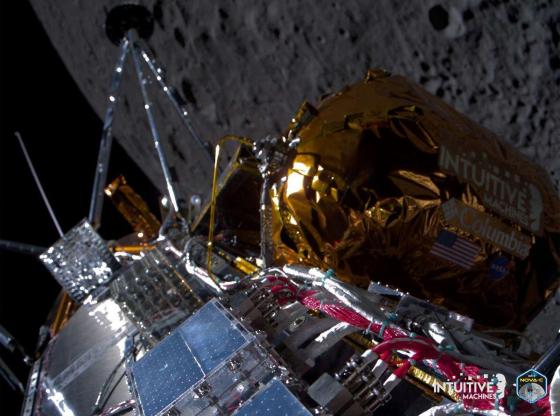

In an unprecedented achievement, the moon lander named Odysseus, operated by Intuitive Machines, has made history as the first privately-owned spacecraft to land on the lunar surface and the first American landing since 1972. Despite a successful landing, Odysseus faced a significant hiccup, ending up on its side after one of its landing feet caught on the lunar terrain during its final descent. This minor setback occurred near the Malapert A crater in the moon’s south pole region, where the lander was intended to settle.
Stephen Altemus, CEO of Houston-based Intuitive Machines, reported that the lander is “alive and well,” stable near its targeted site, and maintaining communication with mission control. Efforts are underway to retrieve the first photographic evidence from Odysseus’s unique perspective on the moon.
Initially, it was believed that Odysseus had landed upright, based on telemetry before the actual landing. However, further analysis revealed its sideways position, resting against a rock. Despite this orientation, most of the six NASA science and technology payloads mounted on Odysseus remain accessible and communicative, a fortunate outcome according to Altemus. The company is optimistic about fulfilling the commercial and scientific objectives of the mission.
However, the lander’s position poses challenges, notably limited communications due to two antennae facing the lunar surface and uncertain solar panel functionality. The successful deployment of an alternative solar array and pre-landing battery charging offers some operational hope.
The mission’s journey to the moon was marked by excellence, notably the flawless performance of its propulsion system, a mix of liquid methane and oxygen, a first in space exploration. The final descent was tense, with a last-minute navigation system issue requiring a novel solution from the engineering team. After a suspenseful period of radio silence post-landing, faint signals reestablished contact, confirming Odysseus’s status but leaving its precise condition initially unclear.
Tim Crain, Intuitive Machines’ mission director, estimates that the payloads can operate for approximately nine to ten days before the lunar sunset at the pole affects operations.
The unexpected twist in Odysseus’s landing led to a 30% drop in Intuitive Machines’ stock in extended trading, highlighting the high stakes and unpredictable nature of space exploration. This mission underscores the complexities of lunar landings while marking a significant milestone in private space exploration and the ongoing quest to understand and utilize our closest celestial neighbor.