
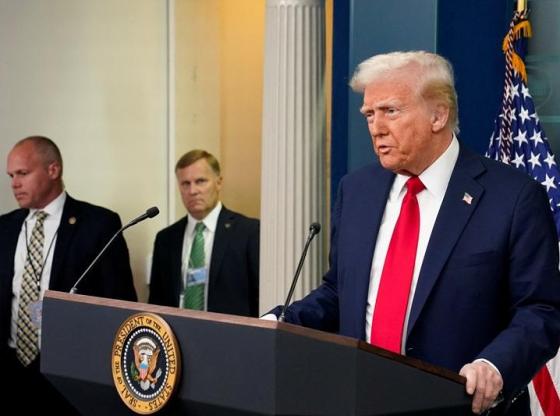

U.S. President Donald Trump has suspended the imposition of steep tariffs on Mexico and Canada for 30 days after securing agreements from both countries to strengthen border and crime enforcement measures. However, tariffs on China are still set to take effect within hours.
The 25% tariffs on Mexican and Canadian goods, initially scheduled to start on Tuesday, were paused following commitments from Canadian Prime Minister Justin Trudeau and Mexican President Claudia Sheinbaum to crack down on illegal immigration and drug smuggling.
Canada agreed to deploy advanced technology and additional personnel along its border with the U.S., while also launching joint efforts to combat organized crime, fentanyl smuggling, and money laundering. Mexico, on the other hand, will reinforce its northern border with 10,000 National Guard members to curb illegal migration and drug trafficking.
In return, the U.S. pledged to help prevent the trafficking of high-powered weapons into Mexico.
“As President, it is my responsibility to ensure the safety of ALL Americans, and I am doing just that. I am very pleased with this initial outcome,” Trump said on social media.
Tariffs on China Still Moving Forward
While tensions with Canada and Mexico have eased, China remains in Trump’s crosshairs. A 10% tariff on Chinese goods is set to begin at 12:01 a.m. ET on Tuesday. Trump warned that these tariffs could increase further if China doesn’t address the fentanyl crisis, which he blames on Beijing.
“China hopefully is going to stop sending us fentanyl, and if they’re not, the tariffs are going to go substantially higher,” Trump said.
China has dismissed the accusations, calling fentanyl America’s problem. The country announced plans to challenge the tariffs at the World Trade Organization (WTO) while leaving the door open for negotiations.
Market and Economic Reactions
The temporary suspension of tariffs boosted the Canadian dollar, which rebounded after hitting its lowest level in over two decades. U.S. stock index futures also saw gains following a day of losses on Wall Street.
Industry leaders, concerned about supply chain disruptions, welcomed the pause. Chris Davison, head of a Canadian canola producers’ trade group, commented, “We have a highly integrated industry that benefits both countries.”
Potential Impact on Europe and Global Trade
Trump hinted that the European Union (EU) could be his next target for tariffs but did not specify a timeline. EU leaders, meeting at an informal summit in Brussels, vowed to retaliate if the U.S. imposes tariffs but also emphasized the need for negotiation, citing the U.S. as their largest trade partner.
Trump suggested that Britain, which left the EU in 2020, might be exempt from any new tariffs.
Economic Risks and Outlook
Trump acknowledged that his tariff strategy could result in short-term pain for American consumers but maintained that it was necessary to curb illegal immigration, combat narcotics trafficking, and bolster domestic industries.
Analysts from ING warned that the original tariffs would cover nearly half of all U.S. imports, requiring the U.S. to more than double its manufacturing output—an unrealistic goal in the short term. Other economists cautioned that these tariffs could push Canada and Mexico into recession and trigger stagflation—a combination of high inflation, stagnant growth, and rising unemployment—within the U.S.