
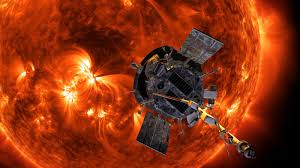

NASA’s Parker Solar Probe has successfully completed the closest-ever approach to the Sun by a human-made object, reaching within 3.8 million miles (6.1 million kilometers) of the solar surface on December 24. The spacecraft remains “safe” and fully operational, NASA confirmed on Friday.
A Record-Breaking Mission
The Parker Solar Probe ventured into the Sun’s corona—the outermost layer of the solar atmosphere—at a speed of 430,000 mph (692,000 kph), enduring extreme temperatures of 1,800°F (982°C).
“This close-up study allows us to measure how material in this region heats to millions of degrees, trace the origins of the solar wind, and explore how energetic particles are accelerated to near light speed,” NASA stated.
The mission’s data is expected to rewrite our understanding of how the Sun works, according to Dr. Joseph Westlake, NASA’s heliophysics director.
Key Highlights
- Signal Received: The Johns Hopkins Applied Physics Laboratory in Maryland received a beacon tone from the probe just before midnight on December 26, confirming its status.
- Data Transmission: Detailed telemetry data will be sent to Earth by January 1, 2025.
A Historic Achievement
Launched in 2018, the Parker Solar Probe uses gravitational assists from Venus to gradually tighten its orbit around the Sun. Dr. Westlake called the mission an “amazing achievement,” bringing to life concepts theorized in the 1950s.
Looking ahead, NASA plans more flybys during the mission’s extended phase, aiming to capture unique solar phenomena and further unravel the mysteries of the Sun.